“The Black Snake” by Mary Oliver
When the black snake
flashed onto the morning road,
and the truck could not swerve –
death, that is how it happens.
Now he lies looped and useless
as an old bicycle tire.
I stop the car
and carry him into the bushes.
He is as cool and gleaming
as a braided whip, he is as beautiful and quiet
as a dead brother.
I leave him under the leaves
and drive on, thinking,
about death: its suddenness,
its terrible weight,
its certain coming. Yet under
reason burns a brighter fire, which the bones
have always preferred.
It is the story of endless good fortune.
It says to oblivion: not me!
It is the light at the center of every cell.
It is what sent the snake coiling and flowing forward
happily all spring through the green leaves before
he came to the road.
Throwback to a recently discovered English II paper and creative response I wrote and created in college.
Mary Oliver’s poem “The Black Snake” is about the circle of life, how the food chain works in an ecosystem, and without death; there would not be life. I was inspired to create this piece of artwork through the natural descriptions Oliver used. The poem’s overall theme is how Mother Nature takes its course and how it affects all living things. There are various aspects of how life can come to an end, which hence this poem is categorized under The Natural and Unnatural section in the textbook. The black snake symbolizes life, death, and rebirth. The human character is an unnamed passerby who sets the reptile in a safe place, to rest in peace. This poem takes place on the side of a road near some bushes.
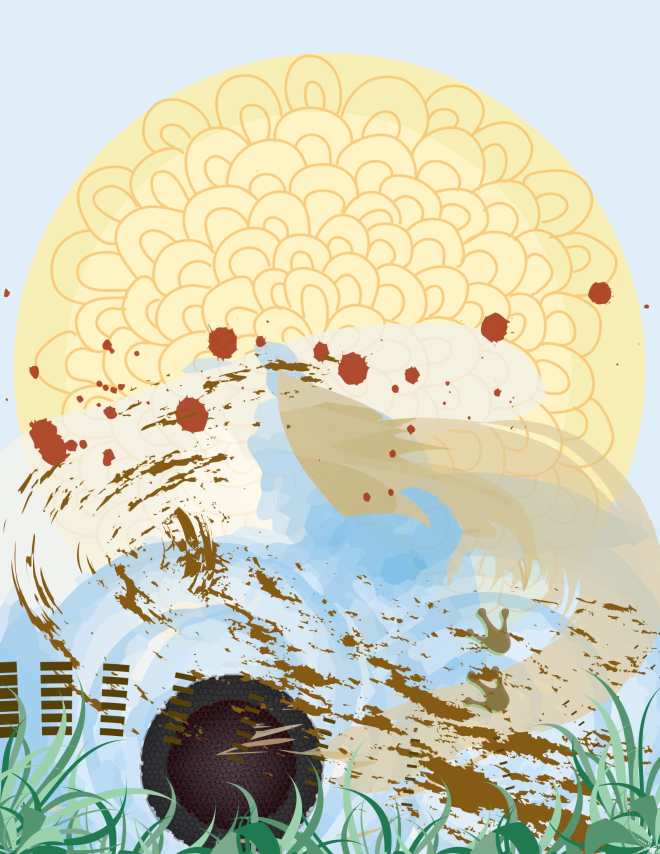
My creative response medium was done in the Adobe software called Illustrator. I experimented with different types of brush strokes because the poem describes nature having endless textures. Oliver compares the lifeless snake resembling a bicycle tire (lines #5-6) and ironically enough, the snake was run over by a truck tire. There are natural and unnatural imprints present; the truck’s tire track marks, the snake’s slithering path, and I added a frog’s footprints.
I chose to use brighter earth tones because the poem takes place on one spring morning (lines #2 and 23). The snakeskin pattern is apparent in the dark circle located, beneath the grass and leaves, at the bottom of the piece. The circle is layered with dark grey and red shades to convey the cool, gleaming, braided whip description (lines #9-10). The piece is bottom heavy and busy to signify the death’s suddenness and weight (lines #14-15).
Under all the chaos that is occurring, the floral sun represents rebirth (lines #16-17). The food chain comes into play: the sun (and rain) feeds the plants, small animals feed on the plants, big animals feed on smaller animals, animals die, their decaying bodies enrich the soil and feed the plants, and the cycle repeats itself (lines #17-21). When using the brush tool, I also applied the spiral free form shape to display the coiling, flowing action of a snake; the process of how life and death transpires, moving on, and the renewal of nature (line #22-23).
My creation comments on the poem by collecting images into a form of art with various materials and arranging them into a collage. It creates a swarm of free form shapes, circles, spirals, and natural elements of earth, air, fire, and water. Sometimes, death can be a muddy, bloody, but beautiful mess. My artwork does reiterate Oliver’s view on nature, life, death, and rebirth. I believe the poet’s intention for naming the title “The Black Snake” is because the color black suggests mourning of the dead. Black does not appear in nature, however only subtle, dark color shades. That is why I created the snakeskin pattern in grey and red. One could argue my creative response as an incorrect interpretation of Oliver’s poem. However, keep in mind, that art is declared art in the eyes of the artist. Everyone has a right to his or her own opinion, critique, and perspective.
I begin every creative response with writing down my initial thoughts, brainstorming if you will; I collect my thoughts, and organize them by drawing a web of ideas. I chose this type of medium, Adobe Illustrator, because it relates to my major, Graphic Design; we most commonly use this program to illustrate artwork that can be transformed into potential products. For example, poets publish books of poetry and sometimes they have illustrations that go alongside each written work. This was the best choice, for me, because I am most comfortable using this program to ensure a clean presentation for the class to observe.
My creation adds to the discussion of the poem because there is a lot to take in, which parallels with the opening stanza of the sudden death. At first glance, there are questions: How did that happen? Why? What’s next? Is there more to it? There are consistent circular and spiral shapes symbolizing the circle of life, visually in my creative response and literally in Oliver’s poem with the looped, bicycle, and endless references. The splattered, smeared brush strokes represent the journey spent and the one that lies ahead. I hope that people can relate to my creative response by appreciating every living creature and embracing that without death, there would not be life. My creation could be used as a teaching tool for the illiterate. Before the written word, there was a source of communication, and that was art.
 A Picture is Worth a Thousand-ish Words